
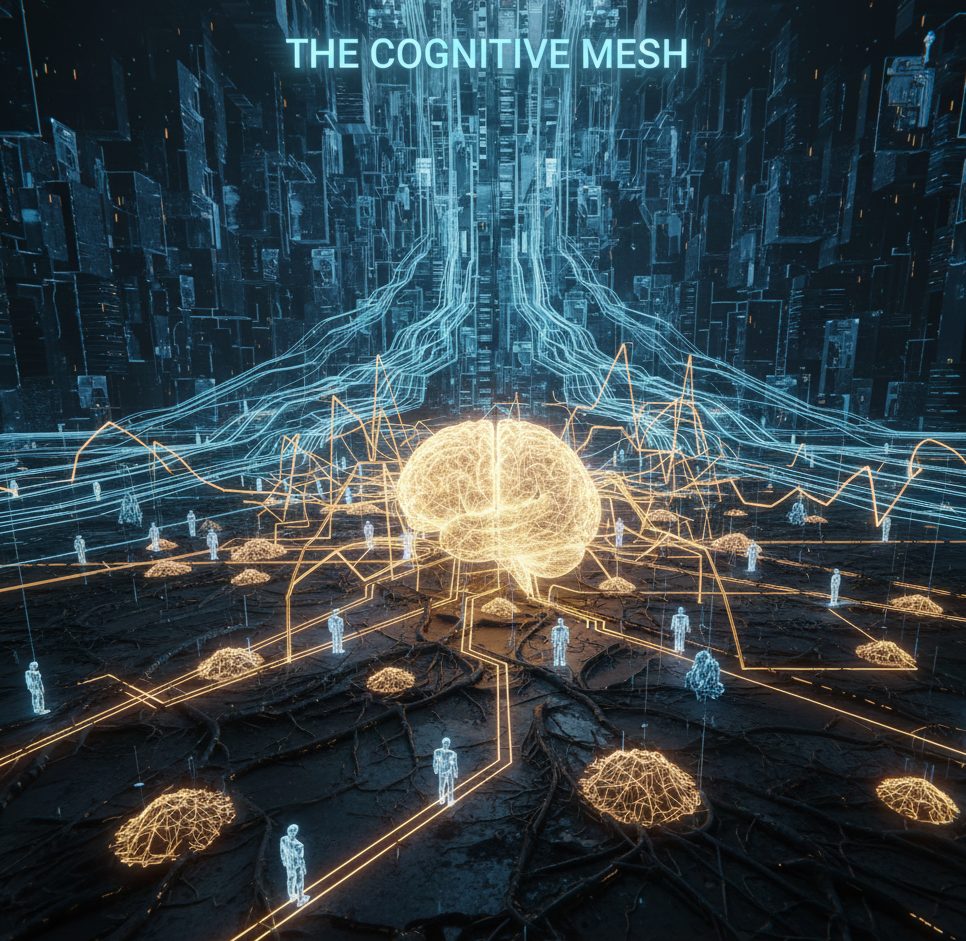
The Cognitive Mesh: A Theoretical Framework for Thinking Clearly in the Information Age
Contents
- 1 Echo and Pulse
- 2 The Discovery
- 3 The Trap of this Protocol
- 4 The source of the problem: Static
- 5 Maybe You Haven’t Noticed It Yet (The Slower Hollowing)
- 6 What Didn’t Work
- 7 Echo Fasting (20-60 Minutes of Nothing)
- 8 The Mesh
- 9 What This Did to My Social Life (Briefly)
- 10 The Structure (Four Layers, But You Only Need the First One For Now)
- 11 What people report (after 2-4 weeks)
- 12 Who This Is For
- 13 What This Gets You
- 14 What I’m Not Promising
- 15 Before You Start: Real Risks
- 16 How to Start
- 17 FAQ
- 18 The Reality Check
Echo and Pulse
Most of your thoughts aren’t yours.
I don’t mean that in a dramatic or self-hating way. I don’t mean this philosophically. I mean it literally.
You’ve absorbed thousands of hours of content. Algorithms showing you what to think about. Other people’s opinions packaged as your own insights. Cultural conditioning so deep you mistake it for personality. Family patterns running through you like code.
Your brain learned these patterns. Now when you “think”, you’re mostly unconsciously pattern-matching. Auto-completing against a massive database of borrowed material. Running scripts.
You feel like you’re thinking. But mostly you’re relaying.
I needed words for what I was noticing, so I made some up. They’re not scientific. They’re just useful.
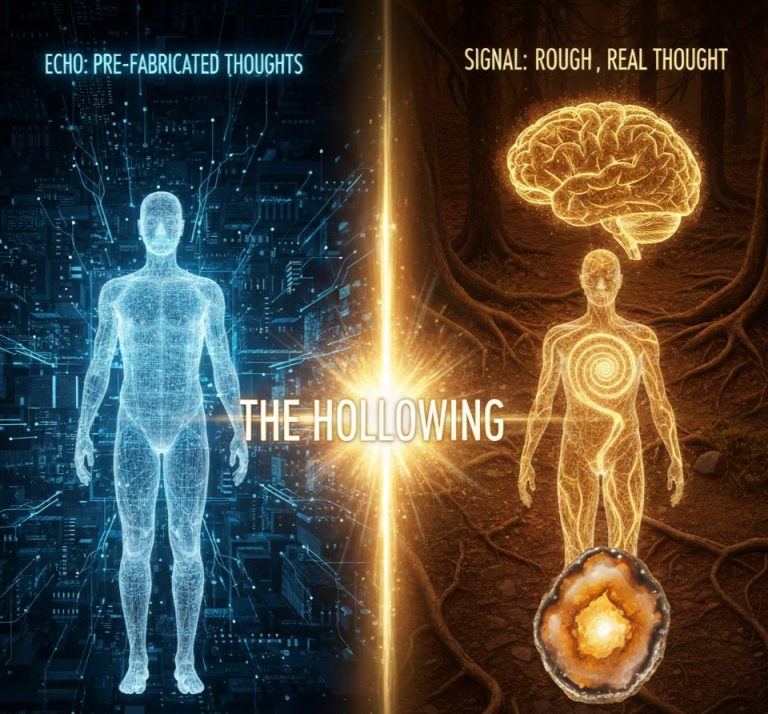
Echo is when a thought arrives fully formed.
It’s fluent. Confident. It fits the moment. It often sounds smart.
But it doesn’t feel built. You can’t trace it to direct experience or observation.
It feels retrieved.
Most of our public thinking lives here.
Pulse is different.
It’s slower. Awkward. Sometimes contradictory. You can feel it assembling as you speak or write.
It’s the rare moment when something actually generates from your direct observation, your lived experience, not from content you’ve consumed.
It often sounds worse.
But it feels real.
The uncomfortable thing is how rare Pulse is.
Once I started paying attention, I realized most days I was almost entirely Echo. Long stretches of time where nothing I thought felt generated, just triggered, completed, relayed.
That’s not a moral failure. It’s a training effect.
I sat down to write this four times and kept making it too smooth. That’s the tell. When you explain something too well, you’re not generating anymore. You’re pattern-matching against every other explanation you’ve absorbed. The clean ones. The ones that make sense.
This thing doesn’t make sense yet. So when I make it make sense, it sounds… hollow.
Let me try differently…
You might notice: this essay is well-structured. It uses familiar online formats. Isn’t that the smooth, pre-formatted thinking I’m warning against?
Here’s the distinction: The observations came from Pulse – months of sitting with The Hollowing, tracing it, testing what worked. That part was clumsy, uncertain, filled with false starts. The communication uses Echo – I’m using structures you’re familiar with so the ideas can actually reach you. I edited this heavily. Cut what didn’t work. Reorganized for clarity.
This is the paradox of pointing at Pulse: I have to use Echo to reach you. But there’s a difference between starting with direct observation then refining it, versus starting with pre-formatted thoughts that arrived complete. The test isn’t whether the final output is smooth. The test is: did you experience the forming process?
The Discovery
I wrote about how I first noticed this phenomenon – what I call The Hollowing
That essay is more of a personal story. The moment I realized my thoughts had stopped feeling like mine.
This article is different. This is about the protocol itself. It’s the map for working with what I found.
Because once you see it – once you feel the difference between Echo and Pulse – you can’t unsee it. It will always be a part of you.
And you realize: this isn’t just a personal problem.
This isn’t an essay about AI. It’s a diagnostic and training protocol for distinguishing generated thought from retrieved thought.
You’ll have a temporary adjustment period where you’re learning a new skill, and it’ll feel awkward, but then you stabilize. If you’re not willing to experience boredom, confusion, and worse writing for a while, stop here. This protocol will not help you.
The Trap of this Protocol
Before you go any further, realize this: This article can also become an Echo.
If you read this, nod your head and think, “This is a great insight”, you have already failed. You have simply added a new high-quality Echo to the database in your mind. You’ve replaced one relay pattern with another.
The biggest danger is that you will use these words: “Pulse, Echo, etc” to describe your hollowing without ever actually stopping it. You will become a more articulate relay station, a person who can quote the Cognitive Mesh while still being hollow.
Do not consume this. Use it.
If this won’t lead to you closing your laptop after reading this article and facing the friction of your own silence, then I have just contributed to your Static. Unfortunately.
The source of the problem: Static
We live in the Age of Entropy.
I’m not talking about physical entropy now. It’s cognitive entropy.
I call it Static – the constant pressure toward average. Algorithmic feeds optimizing for engagement, not truth. Viral opinions that bypass critical thinking. Mass panic or euphoria that moves through populations like weather.
Static loves “consensus”. Static loves “common sense”. If your thoughts never make you feel uncomfortable or lonely, you aren’t thinking – you’re just relayingStatic doesn’t want to destroy you. That would be too obvious.
Static wants you to relay. To be a node in its network, transmitting its patterns without knowing you’re doing it.
And it’s winning, as we can all see.
Because most people can’t tell the difference between thinking and echoing anymore.
Don’t get this wrong, I’m not claiming your thoughts are more TRUE when they come from Pulse. A scientist building on decades of absorbed knowledge – that’s Echo, and it’s how human understanding compounds. You should absorb wisdom from others.
What I’m saying is: there’s a difference between thinking and retrieving. Between being present in your cognition and running on autopilot. Echo can be brilliant and true. Pulse can be clumsy and wrong.
The question isn’t “which thoughts are correct?”. The question is: “Can you feel yourself thinking, or are you just pattern-matching?”
This matters because when you can’t tell the difference – you lose authorship. You become a relay station for whatever you’ve consumed, unable to generate anything genuinely responsive to what’s in front of you.
Your output looks good. Grammatically correct. Well-structured. The kind of thing that gets upvotes, likes, shares.
But something’s missing.
You.
Maybe You Haven’t Noticed It Yet (The Slower Hollowing)
Not everyone experiences this as “my thoughts aren’t mine”. Sometimes it’s just:
You feel dumber than you used to. Can’t focus like before. Reach for your phone constantly without knowing why.
Or: You’re on autopilot. Days blur together. You’re functioning fine, but something’s… flat.
Or: You used to have ideas. Now you mostly have reactions. Someone says something, you have an immediate take, but you couldn’t explain where it came from.
Or: You’ll be mid-sentence and realize you don’t know what you’re saying. The words are coming out smooth, but you’re not connected to them.Or: You open a doc to write something original and… nothing. Blank. So you start reading articles for “research” and three hours later you’ve written nothing but you’ve consumed everything.
You’re functioning. You’re articulate. You’re not in crisis.
But something is thinner than it used to be.
That’s not emptiness exactly, but a loss of pressure. Like the difference between a solid object and a shell.
That’s also The Hollowing.
It doesn’t always announce itself as “these thoughts aren’t mine.” Sometimes it’s just a vague sense that something’s off. That you’re not quite present. That thinking feels harder than it used to.If any of that sounds familiar, you’re experiencing what I’m describing. You just haven’t caught yourself mid-thought yet.
What Didn’t Work
Once I recognized The Hollowing, I couldn’t just live with it, I wanted to fix myself. So I tried things you’d expect.
Meditation helped me notice thoughts, but it didn’t help me tell which ones were mine.
Taking breaks from social media helped temporarily, but everything came back as soon as I returned. Just “detoxing” does nothing really for me.
Mindfulness made me calmer inside the noise, not quieter.
None of those address the actual mechanism: my brain had gotten very good at completing patterns, and very bad at tolerating silence.
The practices below will help you see it more clearly.
Echo Fasting (20-60 Minutes of Nothing)
The first thing that actually changed this: 20-60 minutes daily with zero input. Without this constant Echo consumption.
It’s not a meditation or contemplation. It’s simpler and more annoying than that. But it’s also deeper than it seems.
Sit somewhere. Do nothing. No phone, no book, no music, no “I’ll just organize my thoughts.” Nothing.
First two weeks I failed constantly. Would make it 20 minutes, get unbearably restless, grab my phone “just to check one thing,” then two hours later I’m deep in some Wikipedia article about medieval siege weapons or whatever. The urge to input something is physical. Worse than hunger because you can’t just ride it out. It builds.
Week three I made it the full hour maybe twice.
Week four… something shifted. Not every session. Maybe one in four. Around minute 50, thoughts would start forming that felt different. Rougher. Slower. But with weight to them. I could trace them back to something I’d actually observed, not something I’d consumed.
Echo mapping, Formation practice and habit forming tricks helped a lot.
When it worked, I knew immediately. There’s a texture difference. Echo thoughts feel hollow when you press on them. Pulse thoughts feel dense. That’s the only way I can describe it.
Most sessions: nothing. Just sitting there bored, annoyed, checking how many minutes are left.
But the sessions where it worked made the boring ones worth it.
The Mesh
I call this the Cognitive Mesh because thinking doesn’t happen in isolation.
Once you start distinguishing generated thought (Pulse) from relayed patterns (Echo), something subtle becomes noticeable.
Your thinking stops feeling private.
Not in a mystical sense, but in a structural one. Ideas you form from direct observation often appear elsewhere, independently. Conversations align without coordination. Groups move through moods together.
This isn’t constant and it isn’t magical. It only seems to happen when you’re actually thinking instead of relaying.
I don’t claim a mechanism. Neuroscience, sociology, and network theory all gesture toward this, but none fully explain it. I avoid premature explanations because they tend to replace observation with belief.
So I use a simple working model.
Human minds function as nodes in a shared cognitive field. Most of the time, that field is dominated by Static – averaged, amplified patterns that reward relay.
When you generate instead of relay, you stop reinforcing Static and start contributing something shaped by your position.
That network of interacting minds is what I mean by the Mesh.
You don’t need to believe this to do the work.
But if you pay attention while doing the practices, you’ll probably start noticing what I’m pointing at. Then you can decide for yourself.
If nothing changes, ignore it.
If something does, keep the model provisional.
The starting point is simpler:
can you feel yourself thinking again?
What This Did to My Social Life (Briefly)
For a while, practicing this made me unpleasant to talk to.
People would ask my opinion and I’d pause and realize I didn’t have one.
Or rather, I had a ready-made answer, but I could feel it wasn’t mine.
So I’d say “I don’t know.”
After doing that a few times in the same conversation, someone asked if I was okay. People started avoiding certain topics with me. I’d gotten “weird” or “slow.” And they weren’t wrong.
Bur eventually something stabilized. I got better at sensing the difference in real time. I could still relay patterns when needed. That’s part of living. But I wasn’t confusing them with thinking anymore.
That was the shift.
That’s when I decided that we need a map. A language. A protocol.
Not philosophy. An operating system for consciousness in the information age.
The Structure (Four Layers, But You Only Need the First One For Now)
I tried to keep this simple and just give you one thing. But that felt dishonest.
Because if you do Layer 1 and it works, there are deeper layers available. You should know that going in.
But I think most people will stop at Layer 1. And that’s completely fine. It’s useful on its own.
Layer 1: Recognition (4 weeks):
Learn to distinguish Echo from Pulse reliably. That’s it.
Practices: Echo Fasting, Formation Test, Echo Map, and habit forming practices.
Success marker: You can feel the difference between retrieved and generated thoughts maybe 70% of the time.
For most people, this is sufficient. You catch yourself relaying instead of thinking. You know when to trust a thought and when you’re just playing back absorbed patterns.
Layer 2: Fortification (if you continue)
Building a stable Node. Your coherent center that generates more than it relays.
Practices: Anchors (rituals that generate Pulse), Closing Leaks (systematically removing attention drains), daily maintenance.
This is deep work and may take months.
Layer 3: Integration (if you’re still going)
Seeing the deeper patterns that run through you across time. Family conditioning. Cultural inheritance. The ways your triggers trace back through generations.
You start recognizing: you’re not generating thoughts in isolation. You’re a point where multiple lineages intersect – personal history, family patterns, cultural conditioning, all threading through you. Learning to see these threads, to trace them, to choose which ones to keep pulling.
And each of us is a Node – an intersection of all these threads.
This part needs other people. Hard to see clearly alone. You need others who are working at this level or you’ll gaslight yourself.
Layer 4: [??????] (whenever it emerges, if it does)
I’ve touched it several times. Can’t force it. Can’t really describe it adequately.
Not everyone needs to go there. Any layer is complete without it.
For now: just focus on Layer 1.
If it works, if you keep practicing, the deeper layers reveal themselves naturally.
If it doesn’t work, or if Layer 1 is enough – you stop there.
What people report (after 2-4 weeks)
Not everyone. But enough to be a pattern:
“I can feel when I’m about to relay someone else’s opinion now. There’s a texture difference. Sometimes I still do it, but I know I’m doing it.”
“The weird thing is my writing got worse before it got better. But now when I write something clumsy that’s actually mine, it feels more valuable than the smooth stuff that wasn’t.”
“I thought I’d lose the ability to function. Instead I got more decisive. Because when I do have a thought that’s actually mine, I trust it completely.”
“The hardest part was realizing how much of my personality was just absorbed patterns. But underneath, I found something more real.”
These are real reports from people doing the work. Your results may differ. But they’re consistent enough to be worth investigating.
Who This Is For
I’ve watched twelve people do this. Nine of them got clear results. Two of them got marginal results. One dropped out.
My guess based on that small sample: this works for people who are:
- Currently experiencing The Hollowing (not just intellectually curious about it)
- Stable enough psychologically to handle some disorientation
- Desperate enough to sit doing nothing for an hour daily
- Willing to look stupid for a month
If you’re just intellectually interested, this probably isn’t worth your time.
If you’re in acute cognitive crisis but very psychologically fragile, this might not be the right moment.
But if you’ve felt that hollow feeling where your thoughts should be, if you’ve caught yourself having opinions you didn’t form, if you recognize what I’m describing, this gives you something concrete to try.
Might work. Might not.
But at least you’re not alone with it.
What This Gets You
Not comfort. Coherence.
Clarity
You’ll hear your own voice again. Maybe for the first time. You notice when you’re repeating others vs. thinking for yourself
Creativity
Ideas feel “heavier” and more original
Decision-making
You trust your own judgments more
Power
You’ll stop being a relay station. You’ll become a source. Generating Pulse. Contributing something new to the Mesh, not just passing along what you received.
Connection
You’ll see how you fit into larger patterns. Life stops feeling random. You’re not isolated. You’re woven into something vast. But you’re not dissolved in it either.
You have a location. A Node. A place you stand.
Coherence
Everything aligns.
Your thoughts, your actions, your relationships, your work – all expressing the same pattern.
Not forced, but emergent. This is what it feels like when Pulse runs your life instead of Echo.
Not all at once. Not permanently. But with increasing reliability as your Node stabilizes.
What I’m Not Promising
Not transformation.
Not some kind of enlightenment.
Just learning to distinguish between two types of thoughts. Building the capacity to generate more Pulse and relay less Echo.
Some people find this changes everything. Some people find it marginally useful. Some people find it does nothing.
I can’t predict which category you’ll be in.
The time investment is 20-60 minutes daily plus 5 minutes of tracking.
If after 4 weeks it’s not working, you’ve lost some time but that’s all.
If it does work, you’ll have a way to think more clearly when everything is trying to think for you.
That seems worth testing.
This framework is still evolving. I’m figuring it out as I go. What’s here represents months of daily practice plus observation of others doing the same work. It’s not complete. But it’s workable.
Before You Start: Real Risks
This work can be destabilizing. You’re questioning cognitive patterns you’ve built your life on.
Possible effects:
- Disorientation (not sure what’s “you” vs “absorbed”)
- Social friction (you’ll seem slower, less opinionated)
- Temporary anxiety (if everything’s Echo, what’s real?)
- Grief (recognizing how much was inherited, not chosen)
Do not do this work if:
- You’re currently in mental health crisis
- You have history of dissociation or depersonalization
- You’re isolated without support system
- You can’t tolerate extended uncertainty
- If you experience persistent feelings of unreality, inability to function, or concerning dissociation: stop the practices immediately and consult a mental health professional.
- This work complements therapy; it doesn’t replace it.
Still here? Good. The discomfort is usually temporary and worth it. But go in with eyes open.
How to Start
Download the Layer 1 materials:
- Echo Fasting protocol (44 pages PDF, detailed instructions, troubleshooting, FAQ)
- Echo Map template (standalone HTML file. No internet required. Just open it in browser. It’s used for easy daily tracking without distractions)
- 28-days email support
Practice for 4 weeks.
Track what happens. Notice what changes.
Some people get clear results in 1-2 weeks. Some take longer. Some get nothing and stop.
There’s no way to know which category you’re in except by trying.
If it works you’ll know. The difference between Echo and Pulse becomes unmistakable once you’ve felt it.
If after four weeks of honest attempts you feel nothing, this framework isn’t for you. That’s okay. But you have to actually try it – reading about it does nothing.
The Mesh isn’t waiting for you to become perfect. It’s waiting for you to become coherent.
If it works, you’ll know. Start today.
FAQ
Q: AI is bad?
A: AI isn’t the problem. It’s a mirror.
If your Node is weak, AI becomes Static:
- Amplifying noise
- Flattening your thinking into average patterns
- Training you to think in pre-formatted structures
- Creating the Hollowing
If your Node is strong, AI becomes a tool:
- Extending your processing capacity
- Handling Echo work (summarizing, organizing)
- Freeing your attention for Pulse generation
The question isn’t “should I use AI?”
The question is: Do you know the difference between Pulse and Echo in your own mind?
If you don’t, AI will hollow you out faster than any previous technology.
If you do, AI is just another input to process consciously.
Q: Can I do this while using AI/social media?
A: Yes. The goal isn’t abstinence, it’s conscious distinction. Use them, but know when you’re relaying vs. generating.
Q: How long until I see results?
A: Most people notice difference in Echo/Pulse within 1-3 weeks of consistent Echo Fasting. But stable Node takes several months.
Q: Is this compatible with [my religion/practice]?
A: Usually yes. This is a framework, not a belief system. Most traditions have room for consciousness work.
Q: What if I can’t do Echo Fasting daily?
A: Do what you can. Even 3x week is valuable. But consistency matters more than duration.
Q: Will this make me successful/productive/happy?
A: Maybe. Side effects vary. But those aren’t the goal. The goal is coherence – thinking clearly, generating from observation. Knowing yourself.
The Reality Check
Don’t think of this as salvation. It’s an operating system upgrade.
You’ll still have problems and your life won’t become easy.
But you’ll know the difference between:
- Echo (relaying others’ problems as yours)
- Pulse (responding to what’s actually in front of you)
You’ll still use social media, AI, all of it.
But you’ll know when you’re being used by it vs. using it.
You’ll still feel Static pressure.
But you’ll have a Node stable enough to resist.
![[Echo vs Pulse]: A Guide to Reclaiming Your Thinking](https://allmindslinked.com/up/2025/12/file_00000000ef2c72439fc14a5bbe62391b-768x512.jpg)