[Echo vs Pulse]: A Guide to Reclaiming Your Thinking
If this is your first contact with the idea, you can read this discovery essay first:
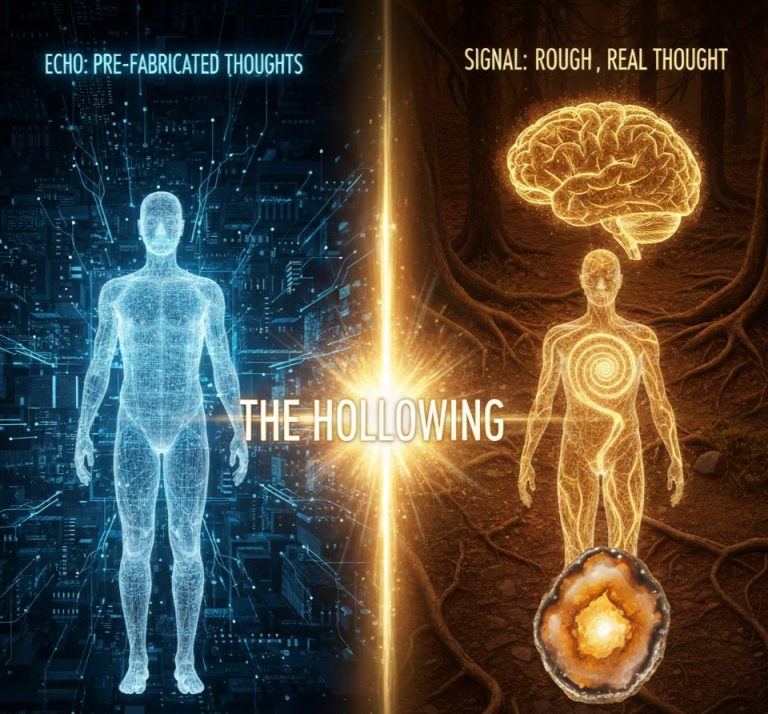
The Hollowing: Recognize When Your Thoughts Aren’t Yours
———————-
I noticed it after several months of heavy ChatGPT use.
My thoughts became perfect.
Grammatically flawless and structurally sound. They arrived in neat three-point arguments with clear topic sentences. If I needed an opinion on something, one would materialize – fully formed, balanced and reasonable.
But something was wrong.
The thing is… I couldn’t feel myself thinking anymore.
It’s hard to explain if you haven’t experienced it. The thoughts were there, as always. They were even good thoughts sometimes. But they felt like they were happening to me rather than through me. Like biting into a piece of wax fruit – looks perfect, tastes like… nothing.
I couldn’t find a term that would describe it properly. But I needed one – I needed to define it precisely in order to be able to deal with it.
So I called this The Hollowing.
And once I had a name for it, I could start working with it. If you can feel it too – you’re not crazy. This is real.
Strange emptiness after hours with ChatGPT, smoothness in your writing that doesn’t feel like real you, moments you realize you can’t think without your feed.
This is observable and it has a name.
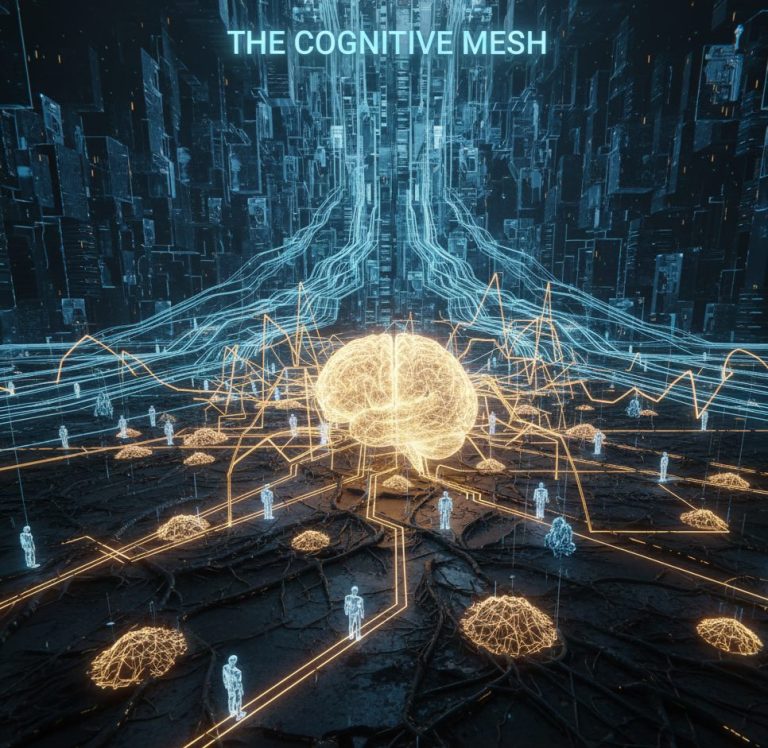
Now we can work with it. That’s why I’m developing the Cognitive Mesh framework.
Contents
The Pattern
Example 1: The Instant Opinion
Someone asks you about… Let’s say, a complex political issue. Before you’ve even finished processing the question a fully-formed opinion appears in your mind. It’s nuanced. It considers multiple perspectives. It sounds intelligent.
But did you actually build that opinion? Did you sit with uncertainty, examining evidence, struggling with contradictions? Or did it just… arrive. Pre-packaged.
Where did it come from?
Yesterday’s Twitter thread. Last week’s podcast. That article everyone was sharing. Your mind pattern-matched against the database of things you’ve consumed, auto-completed to the “correct” opinion, and presented it to you as original thought.
Example 2: The GPT Paragraph
Imagine yourself writing an email. You start typing and the words flow effortlessly. Beautiful prose, with perfectly structured paragraphs and a satisfying GPT-smooth rhythm coming from the tips of your fingers in no time: “It’s worth noting that… On the one hand… However, it’s important to consider…”
But it doesn’t sound like you, does it?
Because it isn’t you. It’s the linguistic patterns you’ve absorbed from months (or years) of reading AI-generated content. Your brain learned the structure, internalized it, and now reproduces it automatically.
You’ve become a relay station.
Example 3: The Borrowed Emotion
You see a news headline. Immediately you feel something. Outrage, maybe, or anxiety, or that specific flavor of algorithmic urgency that makes you want to share it immediately.
But is that your emotion?
Or is it the emotion the headline was engineered to trigger? The same emotion millions of other people felt when they saw the same headline, crafted by the same optimization algorithm?
You’re relaying.
How It Happens
1. You consume algorithmically-optimized content from social media feeds designed for engagement, you constantly read AI-generated texts that are unnaturally smooth, you engage with ciral content engineered for transmission, you read news cycles that trigger specific emotional patterns.
2. Your brain learns these patterns. Sentence structures, argument frameworks, emotional responses, opinion templates.
3. Your brain starts auto-completing against this database. When someone asks you a question your mind searches the database – finds the closest match – presents it as “your thought”.
4. You mistake unconscious pattern-matching for thinking.
It feels like thinking, thoughts are arriving, but you’re not generating. Thoughts are not truly yours.
And the most terrifying part is that you don’t notice.
Why would you? The thoughts are better than your natural thinking. More articulate. More confident. Maybe even grammatically perfect.
Who wants clumsy original thought when you can have smooth algorithmic output? Right? Or maybe…
The Test
Check if you are Hollowed.
The Formation Test (60 seconds):
Think about something you have a strong opinion on. Anything really. Politics, technology, relationships, whatever…
Now ask yourself:
“Can I feel this thought forming? Can I sense it building, piece by piece, from direct observation? Or did it arrive complete?”
If it arrived complete, pre-formatted, ready to speak – in many cases it’s not yours.
The Trace Test:
Take that same opinion. Try to trace it backwards. What specific experience led you to this belief? When did you first form this opinion? What did you directly observe that generated this thought?
If you can’t trace it to direct experience – if the chain leads back to “I read it somewhere” or “everyone knows this” or “it just makes sense” – it’s absorbed. It’s Echo.
Original thought often has friction. It builds slowly, it’s uneven. Sometimes it fails to form at all.
But you can feel it forming and you can trace it. Because it’s yours
Echo arrives complete. Smooth or rough, polished or aggressive – it appears fully formed. You didn’t watch it build.
“Smoothness” can be a good marker when you start. It makes easier to distinguish thoughts on the early steps. But it can give you false positives sometimes.
The main marker is whether you felt the thought forming.
If all your thoughts arrive pre-formed or you struggle to think at all – you’ve been Hollowed.
Why This Matters (And Why It’s Different)
You might be thinking: “This Echo/Pulse thing sounds like mindfulness. Or digital detox. Or just media literacy.”
It’s not.
Mindfulness teaches you to observe thoughts. Good. But it doesn’t distinguish between types of thoughts. It treats all thoughts as equal phenomena to witness.
“The Cognitive Mesh: Echo/Pulse protocol” is about recognizing that some thoughts are structurally different. Some are generated from direct experience. Some are relayed from absorbed patterns. This distinction matters.
Mindfulness is about relationship to thoughts.
This protocol is about authorship of thoughts.
You are not calming thoughts. You are identifying whether a thought was retrieved or built.
Calm Echo is still Echo.
Agitated Pulse is still Pulse.
Digital detox means “using less technology.” Fine. But you can quit social media and still be Hollowed – if you’ve internalized the patterns, they keep running.
The Cognitive Mesh is about recognizing when your cognitive architecture has been rewired by algorithmic patterns.
Media literacy teaches you to evaluate sources. Useful. But The Hollowing happens after you’ve consumed trusted sources. Your brain absorbs patterns from high-quality content too. The New York Times will Hollow you just as effectively as TikTok. It’s just a different flavor.
Note: Echo/Pulse Protocol is Layer 1 of a larger framework I’m developing called The Cognitive Mesh. You don’t need to understand the full framework to use this protocol – it works on its own. [Learn more about the framework →]
This is the map. The work stays local.
What’s Actually Happening (The Mechanism)
You’re thinking comes from direct observation. You can feel confusion/uncertainty. In many cases it’s a slow formation of thought, clumsy articulation, revision.
And only then eventual clarity (maybe).
Hollowed thinking is different. You encounter a situation. Pattern-match against the database in your memory. You get an instant retrieval (or struggle to form any thought at all, if there are no matches). Retrieved thought has perfect articulation.
Done
The second process is faster. It feels like you’re getting smarter.
But you’re not.
You’re getting better at retrieval. Your pattern-matching is improving. But unconscious pattern-matching is not thinking.
This is why people who consume a lot of “smart” content, podcasts, articles, Twitter threads from intelligent people – often become less capable of original thought. They build a massive database of good-sounding ideas, and their brain gets very, VERY efficient at retrieving and recombining them.
But they stop generating.
I see this in myself. I can reference different people, cite studies. I may sound smart. But when someone asks me something outside my database, I freeze. There’s nothing there. Just the whirring sound of pattern-matching finding no match.
The AI Accelerant
This has always been a problem. This phenomenon existed before. Media has always shaped thought. Cultural conditioning has always existed. It’s true.
But AI is a phase shift.
Pre-AI: You absorbed patterns from humans. Sometimes articulate, other times messy, inconsistent, contradictory humans. Your brain had to do work to reconcile different voices, different styles, different structures. Although media shaped the patterns for all their history, people didn’t have the amount of information that we deal with every day now.
Post-AI: You’re absorbing patterns from optimization engines. Content that’s been refined for smoothness, engagement, transmission. With superhuman articulation and in most cases exactly the same structure.
Your brain can’t resist. It’s like introducing refined sugar to a metabolism evolved for fruit. The patterns are too good. Too optimized. Too smooth.
We’re the generation training on an insane amount of polished data we didn’t create. Think about that. We’re learning from machines that optimized those patterns into something our brains can’t distinguish from our own thoughts.
And now these patterns are everywhere:
- Articles you read (often AI-assisted)
- Emails you receive (GPT-polished)
- Social media posts (algorithm-selected for engagement)
- Your own writing (autocomplete suggestions)
- Conversations (people relaying AI-generated ideas)
You’re training on AI-optimized content without realizing it.
And your internal monologue is starting to sound like GPT. Have you noticed it?
Specific consequences:
Loss of authorship – You can’t feel your thoughts generating
Dangerous confidence – You have answers without understanding
Dependency – You can’t think clearly without the algorithm
And maybe even Cognitive atrophy – The thinking “muscle” weakens from disuse
What Gets Lost
The Hollowing doesn’t just make you reliant on absorbed patterns.
1. Texture
Original thought has texture. It’s rough, dense, specific. It emerges from the particular circumstances of your life, your body, your direct experience.
Hollowed thought is generic. Could have come from anyone.
When I write from direct observation, I struggle. I delete sentences. I can’t find the right word. The structure feels awkward. Sometimes I just stare at the cursor for twenty minutes, feeling like an idiot.
GPT never feels like an idiot. But being an idiot is part of being human. The friction is where thought actually happens. But there’s a density to it when it finally comes. You can feel yourself actually thinking. When you relay patterns you absorbed, it just flows. You get perfect sentences with clean structure immediately. But it’s hollow.
You might notice this essay itself is relatively polished. You might think: “Wait, isn’t this the smooth GPT-style you’re warning against?”
Fair question. But editing is fine. Revision is fine. Taking a clumsy thought and refining it through multiple drafts – that’s not the problem.
The problem appears when the thought arrives pre-refined, when you never experienced the clumsy stage at all and most importantly – when you can’t trace it to your direct experience or observation.
I wrote this badly first. Very poorly. I struggled with every section and I deleted more than I kept, honestly. The probable smoothness you’re reading now came from work, not from retrieval. That’s the difference. It’s all about whether you were present in the formation.
2. Discovery
Real thinking involves getting lost. Following a thread that goes nowhere. Being confused. Having half-formed insights that dissolve before you can articulate them.
Hollowed thinking never gets lost. The answers arrive pre-formed. You never experience the uncertainty that precedes actual discovery.
I missed being confused. I used to sit with questions for days, not knowing and now my brain immediately supplied an answer. Smooth, confident, wrong or right – it doesn’t matter.
What scared me the most is that I could’t tell when I was wrong anymore. The retrieved answer feels as certain as direct observation. My confidence is decoupled from my actual knowledge.
3. Your Particular Angle
You have access to observations no one else has. Your specific combination of experiences, relationships, circumstances. This is your only cognitive advantage.
The Hollowing trades this away. In exchange for smooth articulation and instant opinions, you lose your particular vantage point. You start seeing the world through the averaged lens of whatever you’ve consumed.
4. The Ability to Think at All
And this is the real risk.
If you spend years pattern-matching instead of thinking, do you lose the capacity to generate original thought? I don’t know. Really. But I suspect the answer is: partially, yes.Like a muscle you don’t use – it doesn’t disappear, but it weakens. Gets harder to access. Eventually, reaching for it feels unnatural.
Why struggle to form clumsy original thoughts when your database can supply smooth, pre-formed ones?
The Way Out (If You Want It)
Practices: Echo Fasting, Formation Test, etc.
The core practice is what I call Echo Fasting – extended periods with zero input with thought tracing. Not just relaxing, but really tracing your thought. You can do it yourself – you already know the basics of formation test and I guess
It sounds simple. And in fact, it really is simple. The difficulty lies in sticking to it. When you know the main stages, what to expect, when you know when something might go wrong and how to deal with it, when you know when to stop if it starts to do more harm than good, when you know how not to confuse Echo and Pulse – it becomes much easier to stick to the practice and not get lost in your mind.
I’ve developed a detailed protocol for this (duration, timing, what to expect week-by-week, how to handle failures).
It’s the foundation of the work.
[Echo/Pulse Protocol: The 4-Week Protocol to Reclaim Your Thoughts
The pre-formed thoughts start to become more quiet. The pattern-matching system runs out of fresh material. And underneath, if you’re patient, something rougher starts to emerge.
Your actual thoughts. Maybe clumsy, fragmented, uncertain. But yours.
The first time I felt this… It was incredible. I don’t even know how to describe that feeling. Don’t get me wrong, not because the thoughts were profound. They actually weren’t, to be honest… But because I could feel myself thinking again. It felt like waking up after years of sleepwalking.
Throughout the day, catch yourself thinking and ask yourself: “Is this my real thought or am I relaying?”. Over time, you’ll develop sensitivity to the texture of different thoughts. Echo vs. generated. Borrowed vs. observed.
It’s like developing taste. At first, all wine tastes like wine. Then you start noticing: this one’s dry, that one’s fruity, this one has an aftertaste I can’t place.
Same with thoughts. At first, they’re all just… “thoughts.” But then you start feeling the difference. And you won’t be able to un-see it again.
What I’m Not Saying
I’m not saying “never consume content”
Absorbing ideas is fine. Necessary, even. The problem is when absorption replaces generation. When you can’t distinguish between the two anymore.
I’m not saying “all absorbed patterns are bad”
Some patterns are useful. Language itself is absorbed patterns. Cultural knowledge. Expertise in any field. The problem is unconscious absorption. When you’re relaying without knowing you’re relaying.
I’m not saying “AI is evil”
AI is a tool. AI/”language models” are useful. I don’t consider technology to be a problem. But I do consider unconscious training of your cognitive patterns on optimized content to be one.
I’m not saying “All Echoes are smooth and fast”
Scientific insights do happen. And they often arrive complete.
BUT (and this is REALLY important to keep in mind):
- After long unconscious processing
- Built on deep knowledge
- Traceable to your work (even if the process is hidden)
Musical melodies can also arrive fully formed. Mathematical proofs sometimes “click” instantly. These are Pulse, even though they arrived complete. You need to keep in mind the main difference:
Instant insight after YOUR work = Pulse
Instant opinion after consuming content = Echo
I’m not saying “All Pulse is clumsy and comes from observation only”
That simply isn’t true. Pulse can come from:
- Direct sensory observation (obviously)
- Abstract reasoning (if you feel it building)
- Ethical deliberation (if you trace the logic)
- Creative synthesis (combining ideas originally)
- Mathematical/logical deduction
But there’s always one common thread: You can trace the process.
Not all Pulse is empirical observation.
But all Pulse is traceable to some cognitive work you did.
I’m not saying “never edit or polish your thoughts”
Edit all you want. Revise. Refine. Polish until it shines. The question is: did you generate the raw material? Or did you retrieve something pre-formed and just rearrange it? There’s a difference between starting with your clumsy observation and refining it, versus starting with someone else’s polished idea and relaying it. One is thinking. Other one is curating.
I’m not romanticizing “original thought”
Most original thoughts can be wrong. Or boring. Or derivative in ways you don’t realize.
I’m not saying that all your thoughts are special. The point is – can you generate at all? Or have you become purely a relay station?
I’m not saying “my thoughts are Pulse and others are Echo”
This text can be Echo.
If you read it, agree with it, and keep scrolling… well, it has failed.
I do not control whether this becomes Echo or Pulse for you. I only describe the distinction, that’s all.
The Deeper Question
One thing kept me up at night once I noticed The Hollowing. How much of what I think of as “me” is actually absorbed patterns I’m relaying? My political opinions… are they mine or am I just relaying the consensus of my information diet?My aesthetic preferences… did I develop those or absorb them from algorithmic feeds showing me what “people like me” enjoy? My sense of what’s important – is that from direct observation or from what gets amplified in my media environment? My writing voice – is this how I naturally express myself or have I internalized the smooth GPT-optimized style? My entire personality – how much is direct, how much is relay?
I don’t have an answer.
But I know that before you can answer that question, you have to be able to tell the difference.
And the truth is, most people can’t.
Why I’m Writing This
I’m writing this anonymously because it doesn’t matter who I am.
What matters is – do you recognize this?
Have you noticed your thoughts becoming smoother but hollower?
Have you caught yourself having perfect opinions you didn’t actually form?
Have you felt the struggle to form any thought at all without the help of AI?
If yes, you know what I’m talking about.
If no, try the 60-second Formation Test. Pick any strong opinion you have. Ask yourself: “Can I trace this to something I directly observed, or did I absorb this?”
If you can’t tell the difference, you might already be Hollowed.
What Happens Next
I don’t know if this essay will resonate with anyone.
But I suspect there are a lot of people who’ve noticed something similar. Who feel like their thoughts don’t quite belong to them anymore. Who are tired of being lost in those echo chambers among bots. Who can sense the difference between algorithmic output and original observation, but don’t have language for it.
If that’s you, here’s what I’m offering:
A protocol for distinguishing absorbed patterns (Echo) from generated thought (Pulse).
Practices for rebuilding the capacity to think, not just retrieve.
A recognition that this is a real phenomenon, not just “information overload” or “distraction.”
This is structural. Your cognitive architecture is being reshaped by algorithmically-optimized content. And unless you actively work against it, you’ll keep getting better at relaying and worse at generating. Until one day you realize that the thoughts in your head aren’t yours anymore.
They never were.
Or worse – there will be nothing left of you to even realize it.
The 60-Second Action
If nothing else, do this:
For the next 60 seconds, just sit. No input. No phone. No reading this.
Notice what thoughts arrive.
Do they arrive pre-formed and complete?
Or do they form, slowly, clumsily, with effort? Can you trace them? That’s the difference. That’s The Hollowing.
Now you know what to look for.
What to do Now
You can try and start practicing. Subscribe to the newsletter to receive additional tips, updates, and news:
For a guided experience: Echo/Pulse Protocol is already available
If this resonated, you can find the complete protocol for reclaiming your thinking here:
The Echo/Pulse protocol: the 4-week guide to reclaim your thoughts
But keep in mind:
This is not just a newsletter. It’s not more content to consume.
Don’t follow if you’re looking for interesting ideas to add to your mental database. Don’t subscribe if you want just smooth, polished insights delivered to your inbox.
Follow only if you’re ready to start generating instead of relaying.
Only if you’re willing to sit with the uncertain process of actual thought. The real thought.
Only if you want your thoughts back.